
How Much Does Attracting Foreigners Affect Sales?
The Revenue Impact of Inbound Tourism: A Look at Actual Data
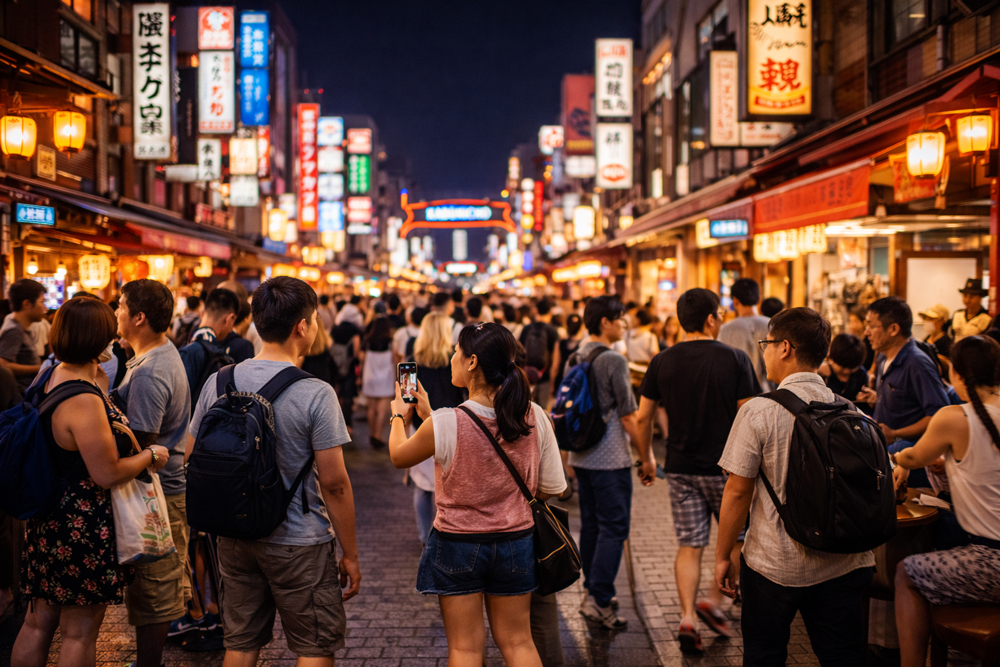
In recent years, driven by the expansion of inbound tourism demand, the proportion of foreigners in the nightlife sector has been gradually increasing. In fact, the total market size of the nighttime economy—including nighttime consumption—has reached approximately 9.8 trillion yen, and this growth is attributed to the rise in inbound spending. Against this backdrop, attracting foreigners must be viewed not merely as a source of additional revenue, but as a factor that transforms the overall revenue structure of a business.
■ The Impact of Inbound Tourism on Sales

First, it is important to note that inbound tourism has already become a core component of the tourism industry, expanding to account for approximately 30% of the entire tourism market. This impact extends beyond food and beverage and accommodation to nighttime services as well; particularly in urban areas, there are increasing instances where the rise in foreign visitors directly influences sales.
Furthermore, as the number of foreigners visiting Japan increases, occupancy rates and spending on accommodation and tourism-related services have also grown significantly; some data indicates that the number of overnight guests has more than tripled over the past few years. This trend is also linked to the nightlife sector, with spending expanding in the form of “daytime sightseeing + nighttime consumption.”
■ Three Key Factors Affecting Revenue

There are three main reasons why attracting foreigners drives changes in revenue.
① Higher Average Spend
Compared to Japanese customers, foreigners tend to prioritize “experience over price,” and in many cases, they are willing to accept higher prices as long as a certain level of quality is guaranteed. In fact, tourism data shows that the average spending per foreign traveler is in the tens of thousands of yen, which is significantly higher than that of Japanese travelers.
The same applies to nightlife services; by setting prices specifically for foreigners,
- a higher price range than usual
- an increase in the utilization rate of optional services
can be expected, which ultimately leads to an increase in average revenue per customer.
② A continuous influx of new customers
While Japanese customers are expected to return, the foreign market is one where “new customers are constantly coming in.” The number of tourists visiting Japan remains in the tens of millions annually, and as some of them flow into night services, they serve as a continuous source of new customers.
In other words, even if the repeat rate is low
, the
structure ensures a steady influx of new customers every month, making it possible to build a stable revenue base.
③ The market itself is expanding
The nighttime economy continues to grow alongside the expansion of inbound demand, and it is projected to expand further in the future due to increased foot traffic and rising average spending. This means that rather than competing for a fixed existing market, the market itself is growing; therefore, the earlier you enter the market, the more advantageous it is.
■ How Much Will Sales Actually Change?

This isn’t just a matter of perception; based on real-world data, the following changes occur:
- Average Customer Spend: Often increases by 1.2 to 1.5 times
- Customer base: Primarily new customers (leading to higher turnover)
- Revenue Structure: Shifting from Japanese-dependent to diversified
Looking at the data, since foreigners are tourists, they are not expected to be repeat customers; instead, new visits are the norm. Therefore, unlike the previous revenue structure that relied on regulars, a constant influx of new customers is expected. As a result, visit cycles tend to shorten, and turnover rates increase. For example, during weekends or tourist seasons, the number of visits often spikes over a short period, and depending on the time of day, occupancy rates can rise significantly higher than usual.
Even more important is the change in the revenue structure itself. Stores that previously relied on Japanese customers tended to see visit numbers and revenue concentrated among a specific demographic, but by attracting foreigners, revenue becomes more diversified. In other words, the business becomes less susceptible to fluctuations in Japanese customer behavior and can better smooth out demand peaks and troughs. Particularly during peak tourist seasons or long holidays, revenue is generated through patterns that differ from those of Japanese customers, making it easier to secure stable overall earnings.
A particularly significant aspect of this is that an increase in average spending per customer and an influx of new customers can occur simultaneously. With conventional customer acquisition strategies, there is often a trade-off: increasing the number of customers tends to lower the average spending per customer, while raising the average spending per customer tends to reduce the number of customers. However, with inbound tourism, there is potential for both of these metrics to improve at the same time.In other words, the key feature is the creation of a situation—where both average spending and the number of new customers increase simultaneously—which is difficult to achieve with conventional strategies. If you understand this structure and leverage it appropriately, the trajectory of your sales growth itself will change.
What is particularly important is that both average transaction value and new customer acquisition increase simultaneously. While conventional customer acquisition strategies often improve only one of these factors, inbound marketing influences both.
■ Characteristics of Stores That Fail to Grow Revenue
On the other hand, not all stores can increase their revenue. There are common factors among those that fail.
- Information is not reaching foreigners
- Lack of advance explanation leads to frequent issues
- Customer acquisition channels remain geared toward Japanese customers
A particularly common pattern is “able to serve customers but unable to attract them.” Since foreigners do not search in Japanese, relying solely on Japanese-oriented SEO often means they won’t even notice the store’s existence in the first place.
■ The Perspective Needed to Boost Sales
What’s crucial here isn’t just handling inquiries, but “strategic planning.”
- Who (country/language)
- Where (search engines, social media, communities)
- What (services, rules)
It is essential to organize these elements in advance and ensure customers understand them before they even arrive.
In other words, “explaining
after they arrive” is too late
; “ensuring they understand before they arrive” is the right approach
.
■ What changes when you use Fu-ZoKlook?
By using a system like Fu-ZoKlook, it becomes possible to comprehensively address this “pre-visit planning.”
- Multilingual Information Dissemination
- Understanding rules in advance
- Direct outreach to international users
As a result,
- Attracting high-spending customers
- The burden of explanation is reduced
- Fewer issues
creating a natural flow.
■ Summary
Inbound marketing isn’t just about boosting sales; it’s a strategy
that transforms the revenue structure itself.
- Higher average transaction value
- New customer inflow increases
- The market expands
Because these three factors occur simultaneously, the impact on revenue can be significant if the strategy is designed properly.
And what’s crucial is not just responding to this
trend, but “designing the entire customer acquisition funnel”
.
If you’re serious about attracting foreigners, utilizing overseas-focused channels like Fu-ZoKlook and establishing a system to manage customers even before they arrive is the fastest route to boosting sales.